Selling a company in business and financial services
Business services, receivables management, advisory and service companies: in few Mittelstand sectors is acquisition activity as systematic as it is today. We advise owners on sales and succession, with references such as the BID group, GERMANIA (Scora), Tesch Inkasso and Frischleder, and with direct access to consolidators, private equity investors and family offices.
Why service providers with a recurring book of business are in demand
Service companies are people and portfolio businesses: long-standing mandates, framework contracts and an established team cannot be built in months, but they can be bought in months. That is exactly what consolidators have been doing for years. Capital-backed platforms are bundling facility, staffing and technical service providers into groups, in receivables management large collection groups, family offices and industrial holdings are taking over regional specialists, and among advisory and service companies, from insurance brokers to engineering and audit firms, networks are forming that combine skilled staff and client access.
Besides succession, regulation is a driver: the German Legal Services Act, distribution rules, data protection and rising IT requirements make going it alone more expensive for smaller firms. For owners this creates a seller's market, provided the book of business is properly documented, client loyalty can be evidenced and dependence on the owner is limited. As with every succession: the earlier preparation begins, the greater the room for manoeuvre on price and structure.
Business services
Facility, staffing, catering and technical services, industrial services and outsourcing. Buyers are capital-backed platforms and corporates acquiring framework contracts, regional presence and above all employees. Contract terms, customer concentration and margin per employee are what gets valued.
Receivables management
B2B debt collection, dunning, field service, sector-specific receivables management. Buyers are collection groups, financial service providers and family offices and industrial holdings with a permanent ownership approach, looking for regional specialists with a stable client base and clean compliance under the Legal Services Act. Individual case handling rather than mass collection is a value argument.
Advisory and service companies
Insurance brokers, tax and audit firms, engineering and planning offices, agencies. Here strategic consolidators such as the large broker groups and buy-and-build platforms buy, often as a partnership with reinvestment so that key people stay on board. Joint ventures and majority sales are common.
What buyers pay for in this sector
With service providers, it is not the machine that is paid for but the relationship. Three factors determine the price, and all three can be evidenced and improved before a sale.
Book of business and recurrence
Share of recurring mandates, framework contracts and commissions in revenue, contract terms, cancellation rates and customer concentration. A broadly diversified book with a long history is valued like an annuity stream.
Key people and retention
Who holds the client relationship: the owner or the team? A second level with its own client access, participation or bonus schemes and low staff turnover reduce the buyer's risk. Earn-out and reinvestment bridge the rest.
Compliance and data
Licences and registrations, documentation under legal services, distribution and data protection rules, a robust client or portfolio management system. Buyers scrutinise this closely because shortcomings fall back on them after the purchase. Order before the process saves negotiating room.
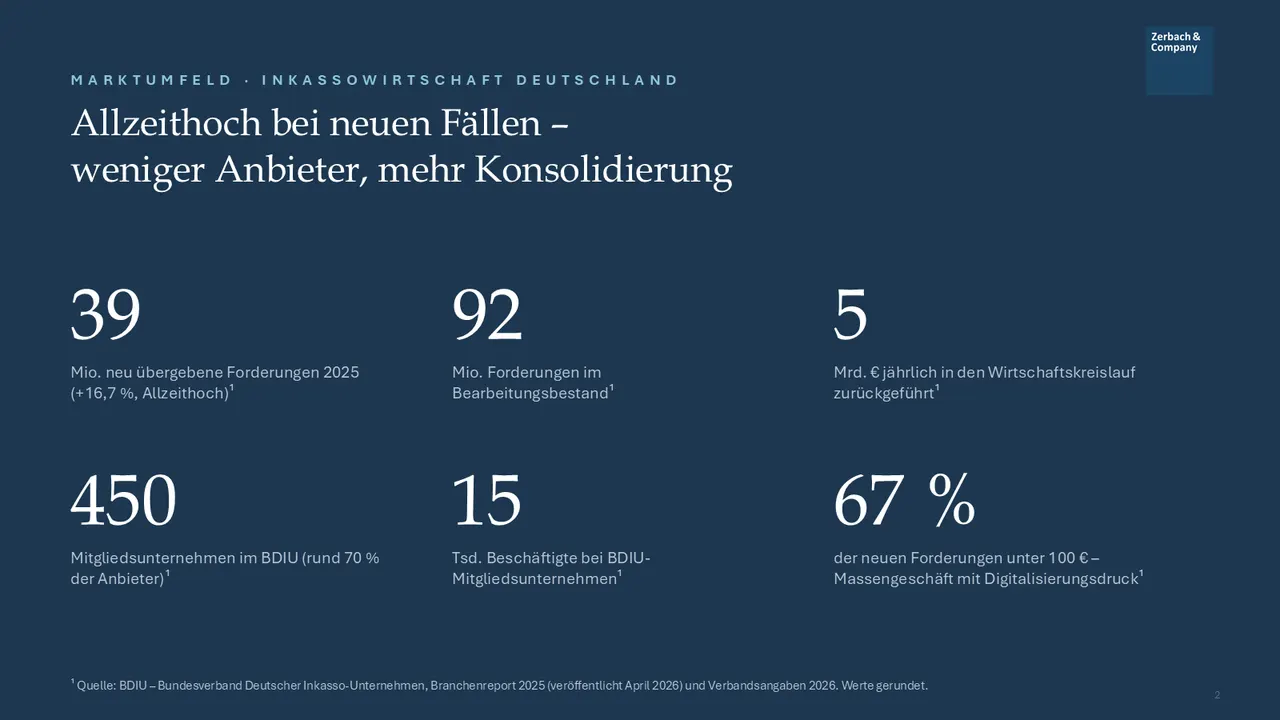
Market data: debt collection and receivables management in the M&A market
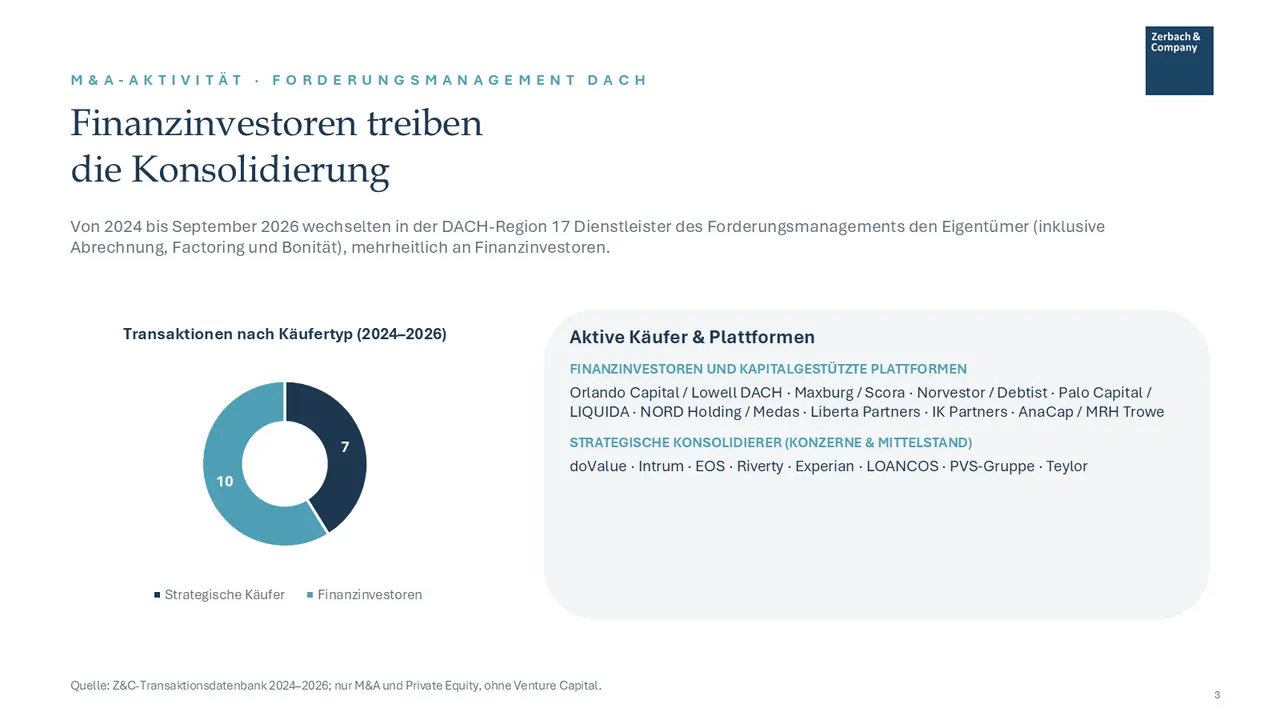
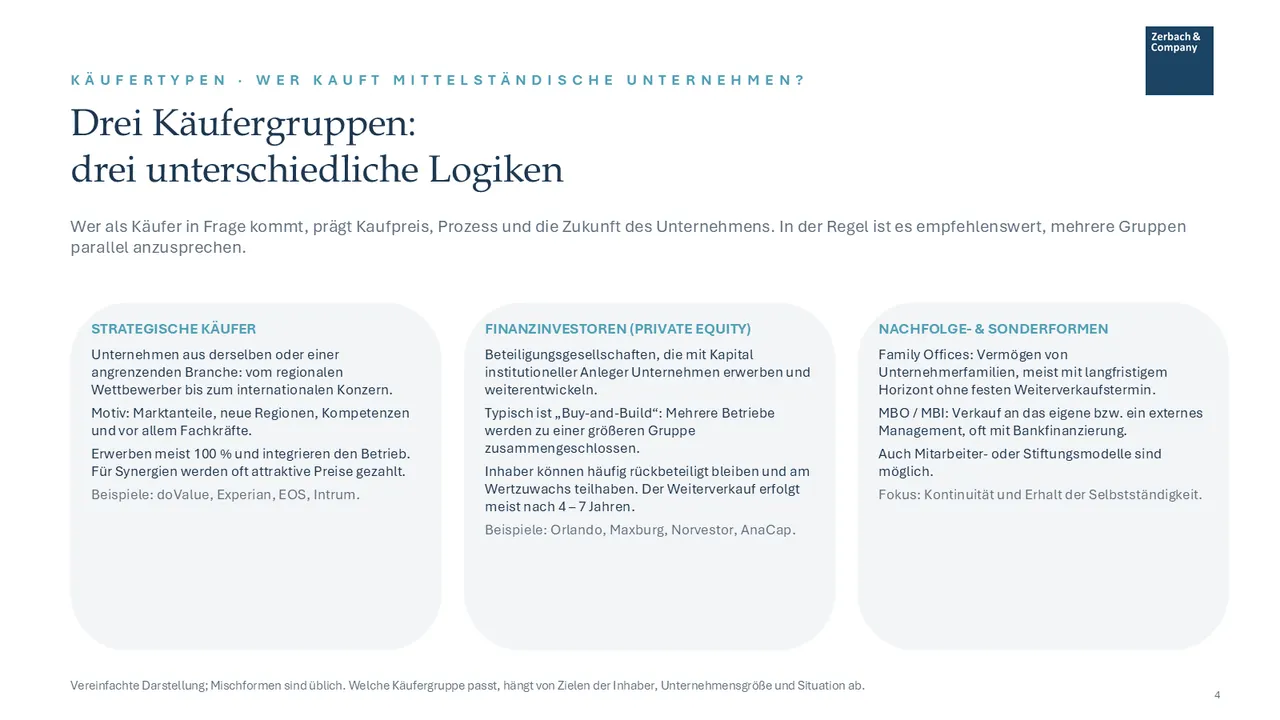
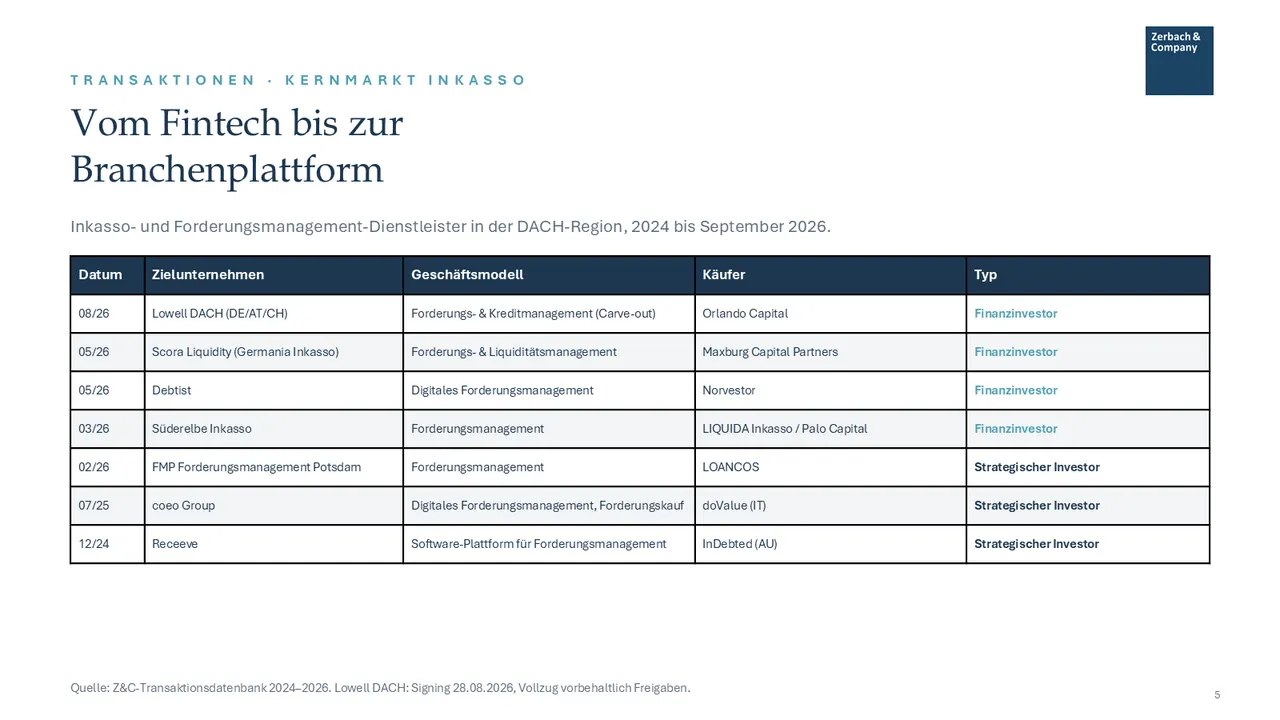
Our semi-annual Industry Update summarises the market environment, transactions, active buyers and valuation level of the sector. The key figures of the September 2026 edition:
Two landmark transactions shape the market: the carve-out of Lowell DACH to Orlando Capital and the acquisition of coeo Group by doValue. Active buyers are financial investors and platforms such as Orlando Capital / Lowell DACH, Maxburg / Scora, Norvestor / Debtist, Palo Capital / LIQUIDA, NORD Holding / Medas, Liberta Partners, IK Partners and AnaCap / MRH Trowe, as well as strategic consolidators such as doValue, Intrum, EOS, Riverty, Experian, LOANCOS, the PVS group and Teylor. Adjacent segments such as billing, factoring and credit assessment are being consolidated alongside.

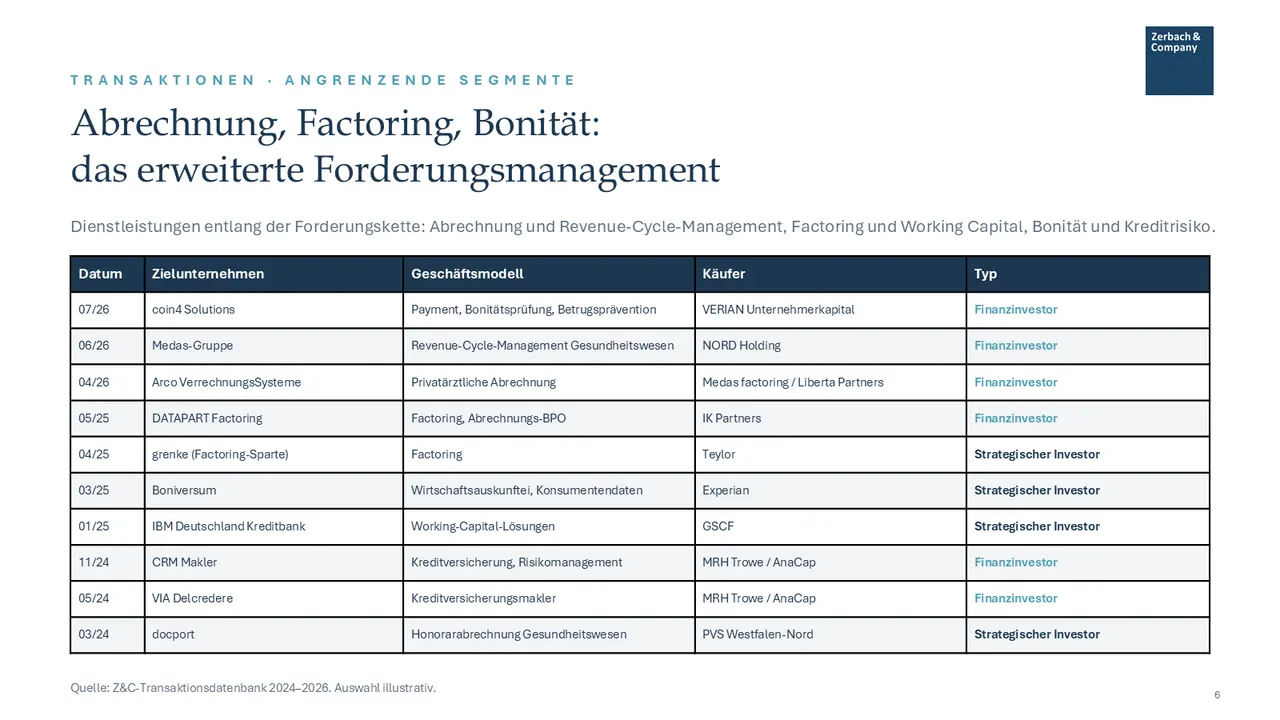
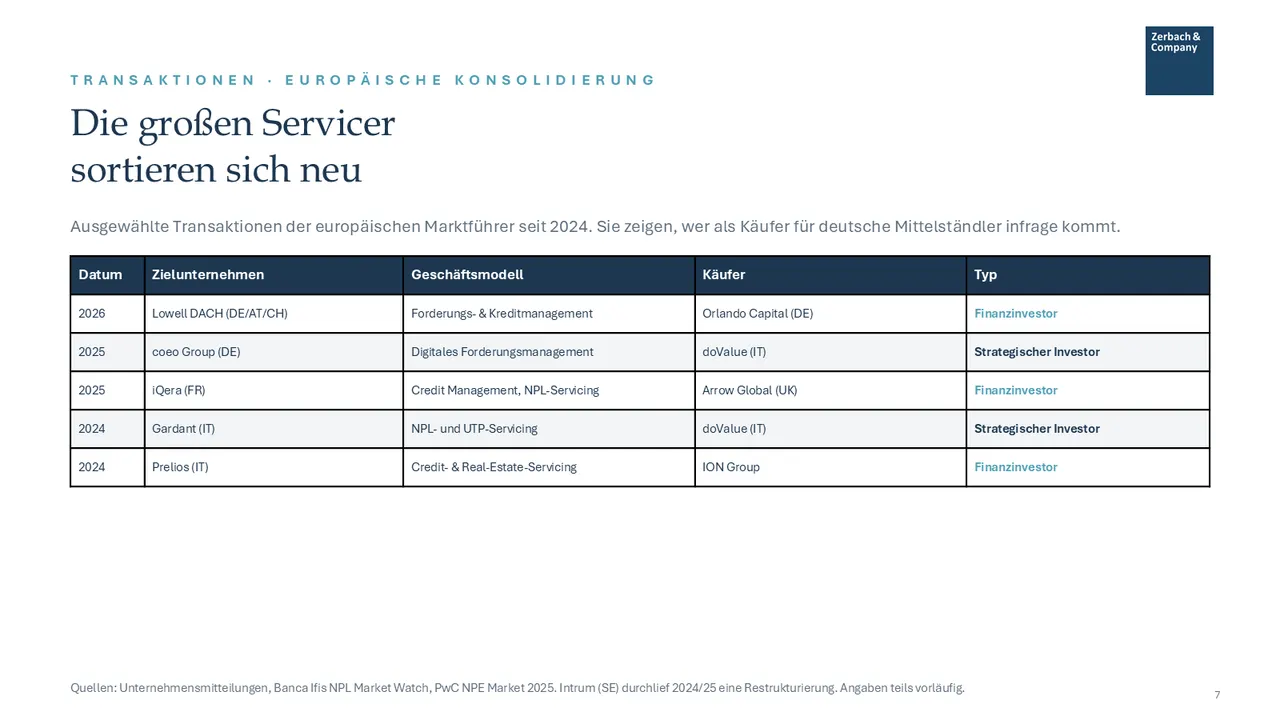
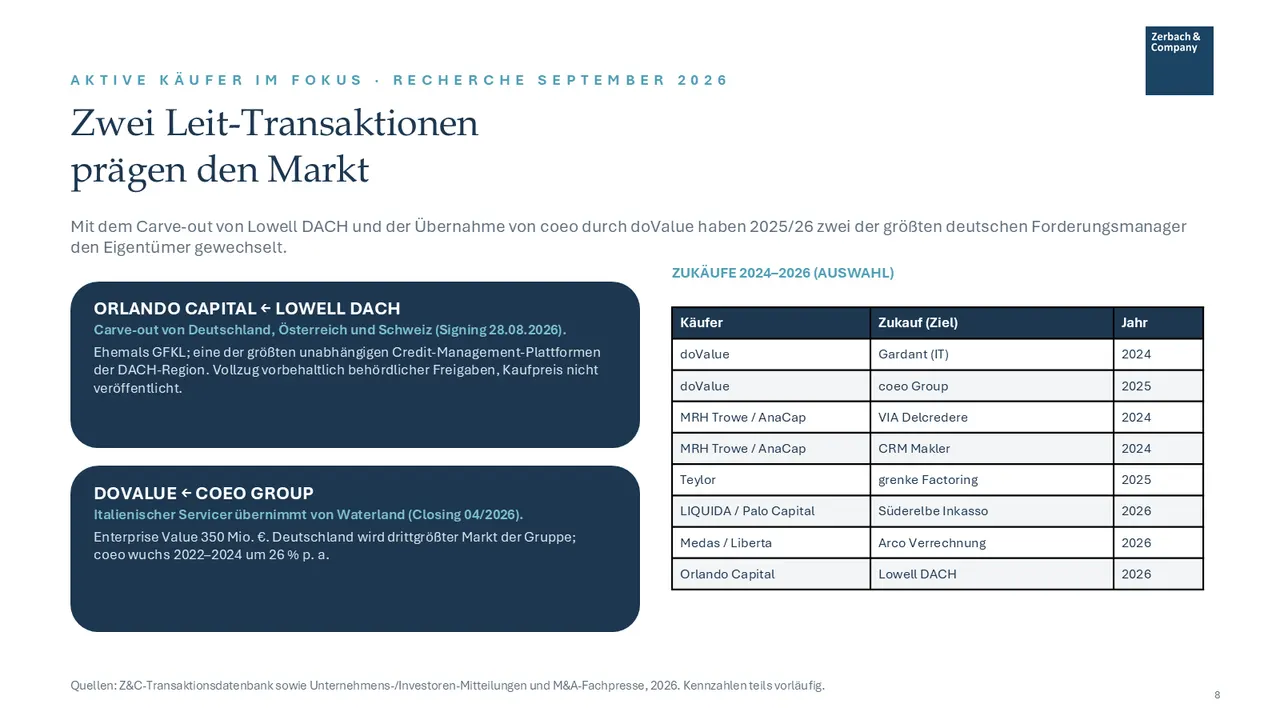
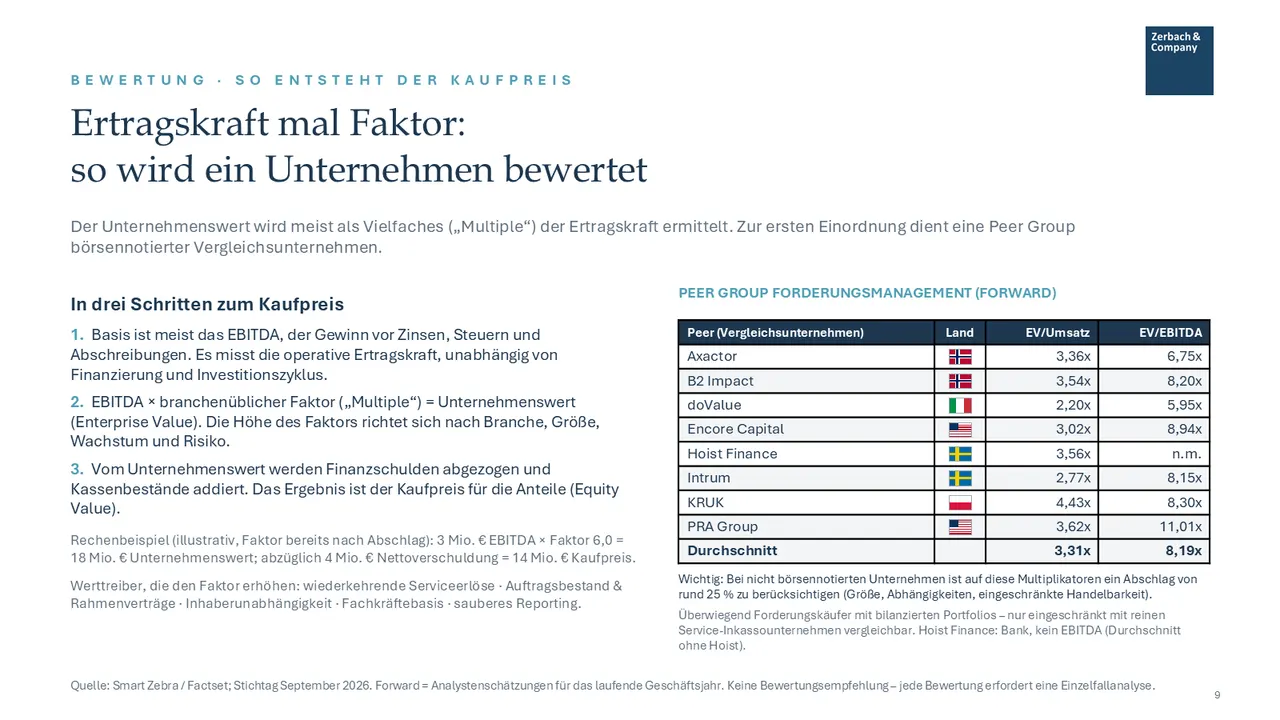

Scroll through the pages; a click opens the page in the PDF. As of September 2026, updated semi-annually. The report is in German.
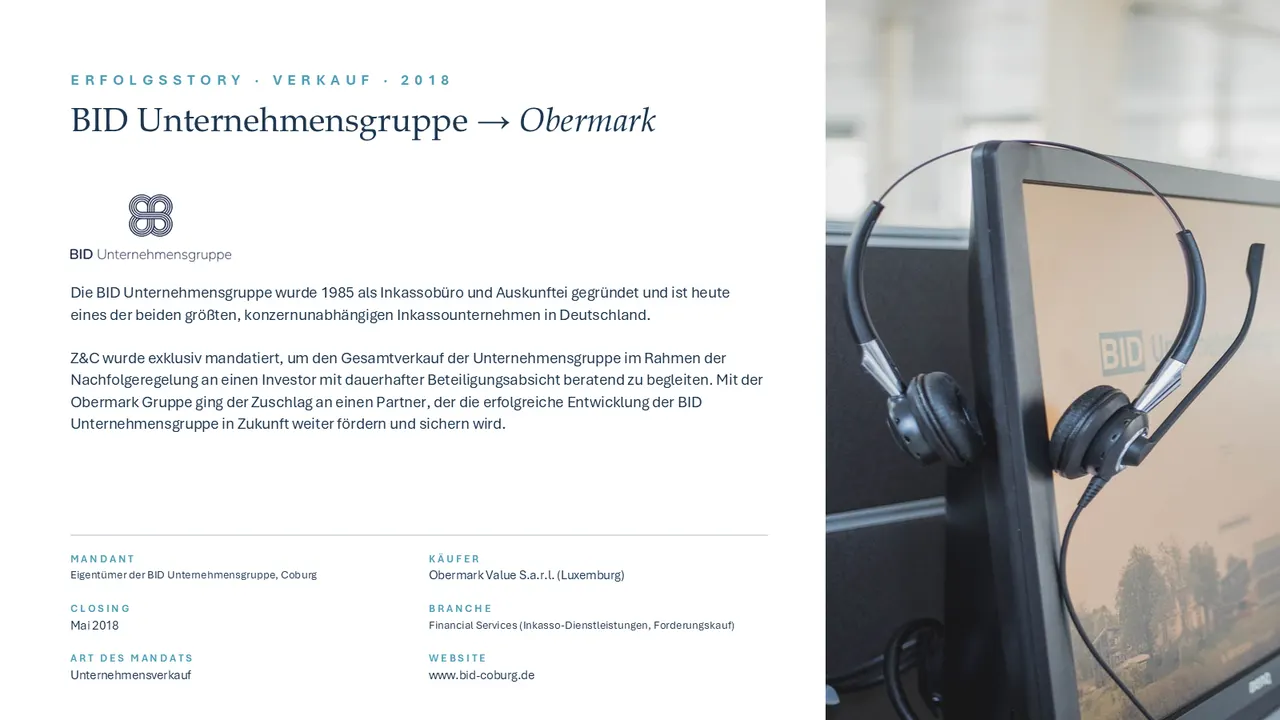
BID group → Obermark
The BID group from Coburg operates in receivables management with around 350 employees. To settle his succession, the founder sold all shares to the Obermark group, a Luxembourg-Swiss industrial holding with a permanent ownership approach that explicitly regards the life's work of founders as part of its investment logic. For an owner-driven service company, this is the solution that combines continuity for clients and employees with a fair price.
To the success story →From receivables management to the specialist insurance broker
Industrial holding with a long-term view, family office, strategic consolidator, joint venture: our transactions with service providers show how different the right solution can look.
BID group → Obermark
Receivables management, Coburg, 350 employees
GERMANIA (Scora) / EURANIA → family office
Receivables management, Deggendorf
Tesch Inkasso
Receivables management
Frischleder → MRH Trowe
Real estate insurance specialist
mensching+
Professional services, partnership model
Questions about selling a service company
How is a service company valued?
The norm is a multiple of sustainable earnings; for brokers and administrators also a factor on recurring commissions or fees. What matters is the composition and stability of the book of business, client loyalty beyond the owner and the quality of documentation. Between a person-dependent sole operation and a service provider with a team, framework contracts and specialisation, valuations are worlds apart. Our fixed-price company valuation provides a first assessment.
What happens to my clients and contracts in a sale?
In a sale of the company's shares, mandates, framework and commission agreements remain unchanged; the contracting party does not change. In a transfer of individual contracts or portfolios in an asset deal, client consent is required. We clarify early with your legal and tax advisers which structure fits, because it affects price and risk.
Who buys service and debt collection companies?
Three groups: strategic consolidators from the same sector, private equity investors with a buy-and-build approach, and family offices and industrial holdings with a long investment horizon. The latter are particularly attractive when continuity for clients and employees is the priority, as with BID and GERMANIA. Only a parallel process shows which group offers the best price.
Are earn-outs or reinvestments common?
Yes, more so with service providers than in other sectors, because value depends on people. An earn-out ties part of the purchase price to performance after the sale; a reinvestment lets you share in further value growth. Both are negotiable; we make sure the conditions are in your hands rather than in the buyer's integration plan.
How long does the sale take?
From preparation to signing we plan for six to nine months. For regulated service providers, time for regulatory notifications or approvals may be added. Confidentiality towards clients, employees and competitors is maintained until signing.
Do you run a service or financial services company?
The first conversation is non-binding and, of course, confidential.