Selling a company in electrical, building and energy technology
Electrical engineering, building services, grid and fibre construction: few Mittelstand sectors are in such demand from buyers right now. We advise owners on sales and succession, with references such as INNECKEN, VISCO and DuoTherm and a network that includes grid service providers, infrastructure groups and private equity investors.
Why buyers are looking for electrical and energy technology now
Grid expansion, fibre roll-out, heat pumps, charging infrastructure and the modernisation of buildings keep order books full, while electricians, switching-authorised staff and project managers are scarce. Companies that want to grow therefore acquire teams, regional presence and framework contracts. Utilities and grid service providers are expanding their installation and service networks, European infrastructure groups are building country platforms, and private equity investors are forming groups of several hundred employees from electrical and building services companies.
For owners this means: a well-run business with 30 to 300 employees, recurring service revenue and a second management level meets more serious buyers today than ever before. At the same time, many of these companies face succession. Together this makes the timing favourable, but it calls for a structured sale process: only by approaching several buyer types in parallel do you learn what the company is really worth.
Electrical and energy technology
Switchgear, medium and low voltage, substations, services for grid operators and industry. Buyers are grid service providers and energy technology groups seeking installation capacity and regional proximity to grid operators. Access to the high-voltage level is a value argument in its own right.
Building services and building envelope
Electrical, heating, ventilation, air conditioning, building automation and security technology, as well as sun protection, windows and facades. Here private equity buy-and-build platforms and building technology corporates are the most active buyers. They pay for service share, maintenance contracts and design expertise.
Grid and infrastructure construction
Fibre (FTTH/FTTB), power lines, cable civil works, district heating and charging infrastructure as general contractor. International infrastructure service providers and infrastructure funds, often backed by private equity, are looking to build or extend a platform in Germany.
What buyers pay for in this sector
Purchase prices are based on sustainable earnings, but in few sectors is the spread between two companies of the same size as wide. Three factors decide, and all three can be shaped before a sale.
Order backlog and framework contracts
Contract terms, customer concentration and the share of grid operators, industry and public clients. Multi-year framework contracts are treated like recurring revenue and valued accordingly.
Team and qualifications
Share of skilled staff, switching authorisations, pre-qualifications and certifications, age structure and staff turnover. A second management level that can run the business without the owner is the single largest value driver.
Service share and clean numbers
Maintenance and service revenue stabilises margins across the cycle. Buyers also scrutinise work-in-progress accounting and project post-calculations closely. Those who are prepared here negotiate from a stronger position.
Market data: electrical engineering service providers in the M&A market
Our semi-annual Industry Update summarises the market environment, transactions, active buyers and valuation level of the sector. The key figures of the July 2026 edition:
Active buyers are strategic consolidators such as VINCI Energies, STRABAG PFS, the GRÄPER Group, Bosch, SCHULZ Systemtechnik, FABRI and Instalco, as well as capital-backed trade and technology groups such as Builtech / VDK Groep, KONZMANN / KLAR, encoviva / GREENPEAK, TSG / HLD, Assemblin Caverion / Triton, HWP Handwerkspartner, InstallerGroup / FSN and Ufenau.
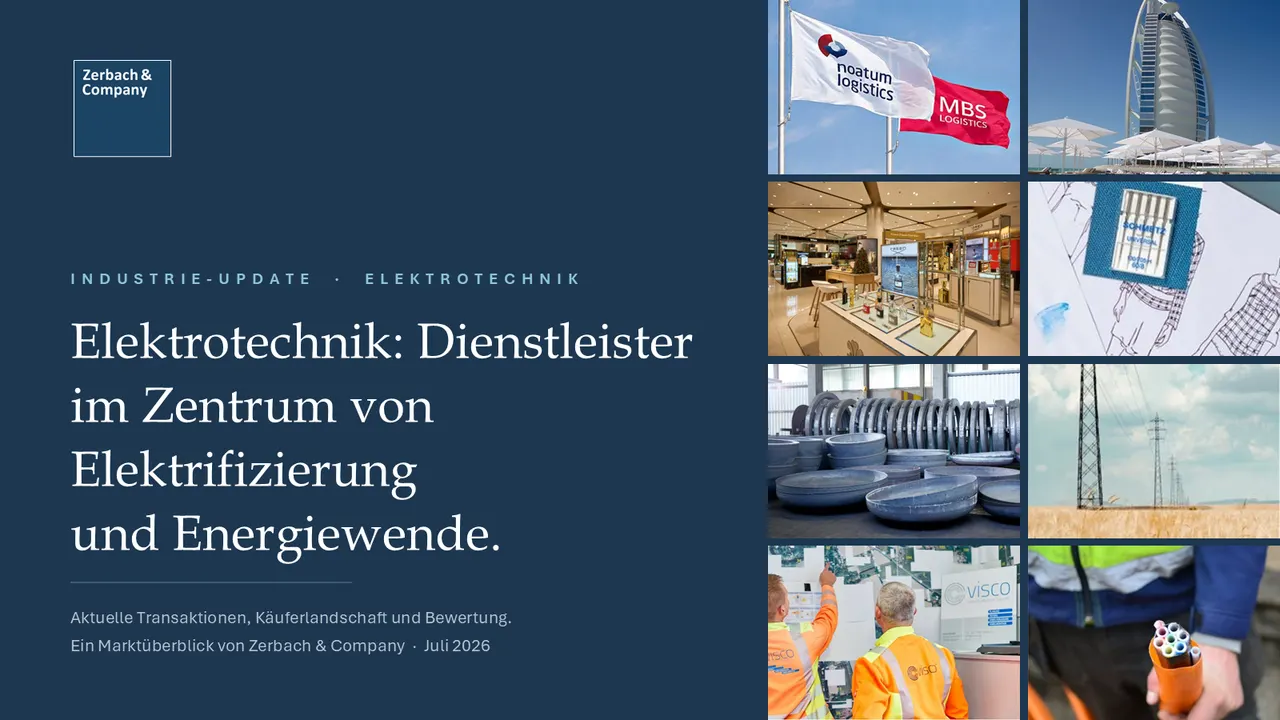
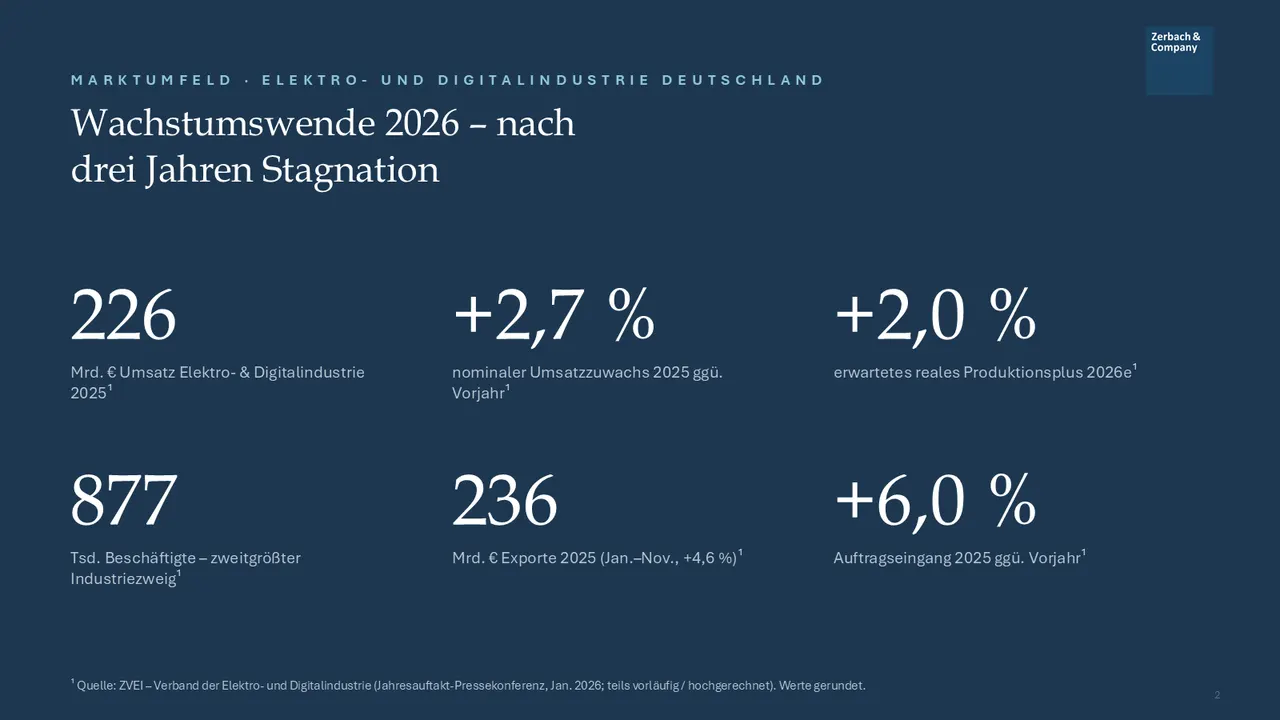
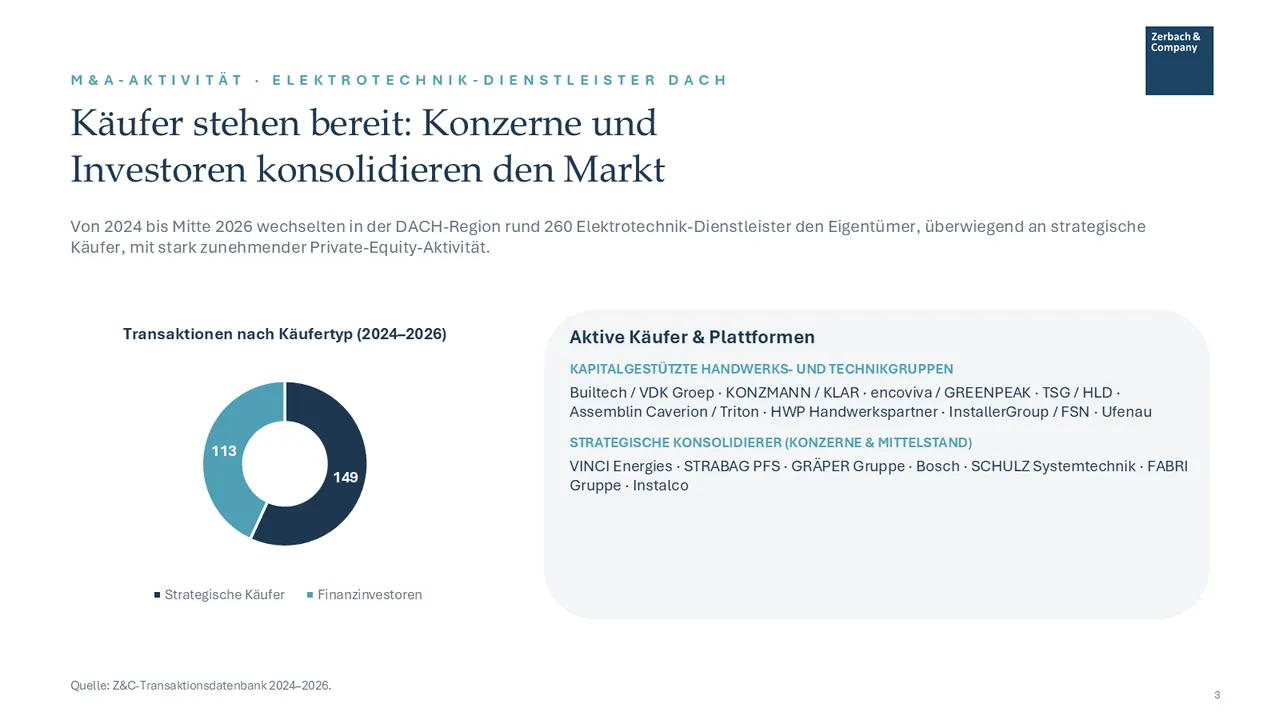
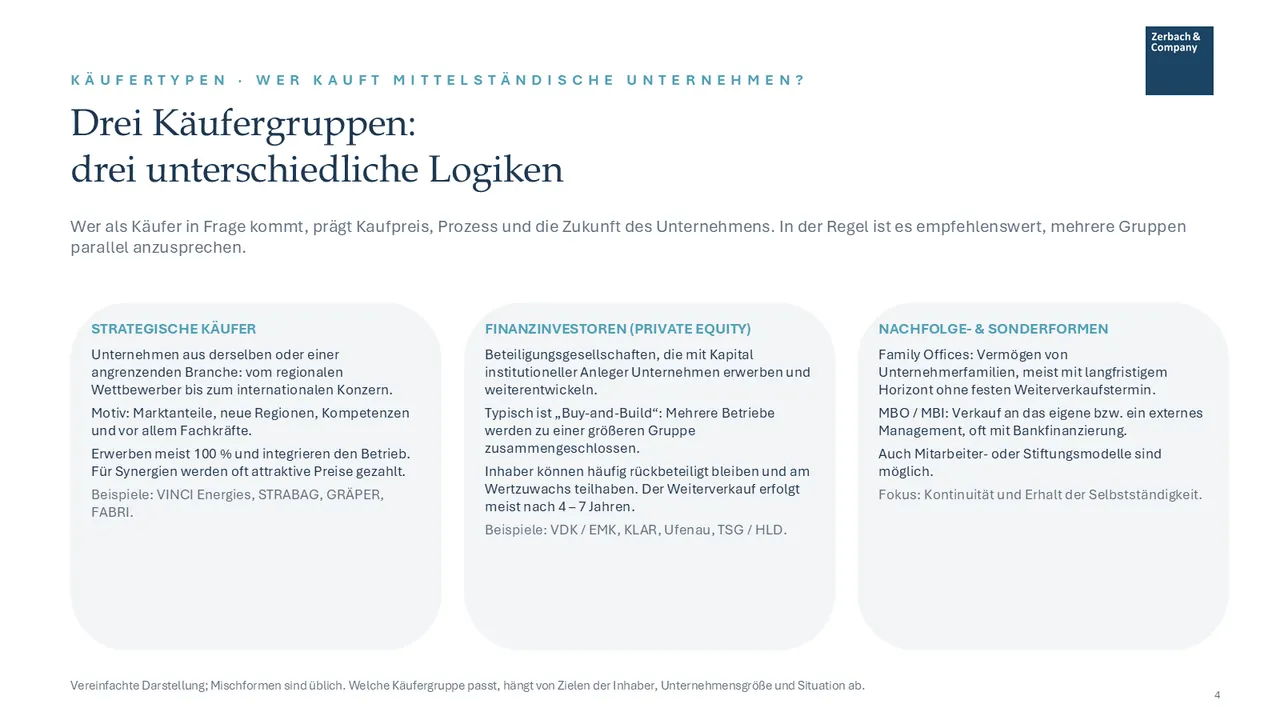
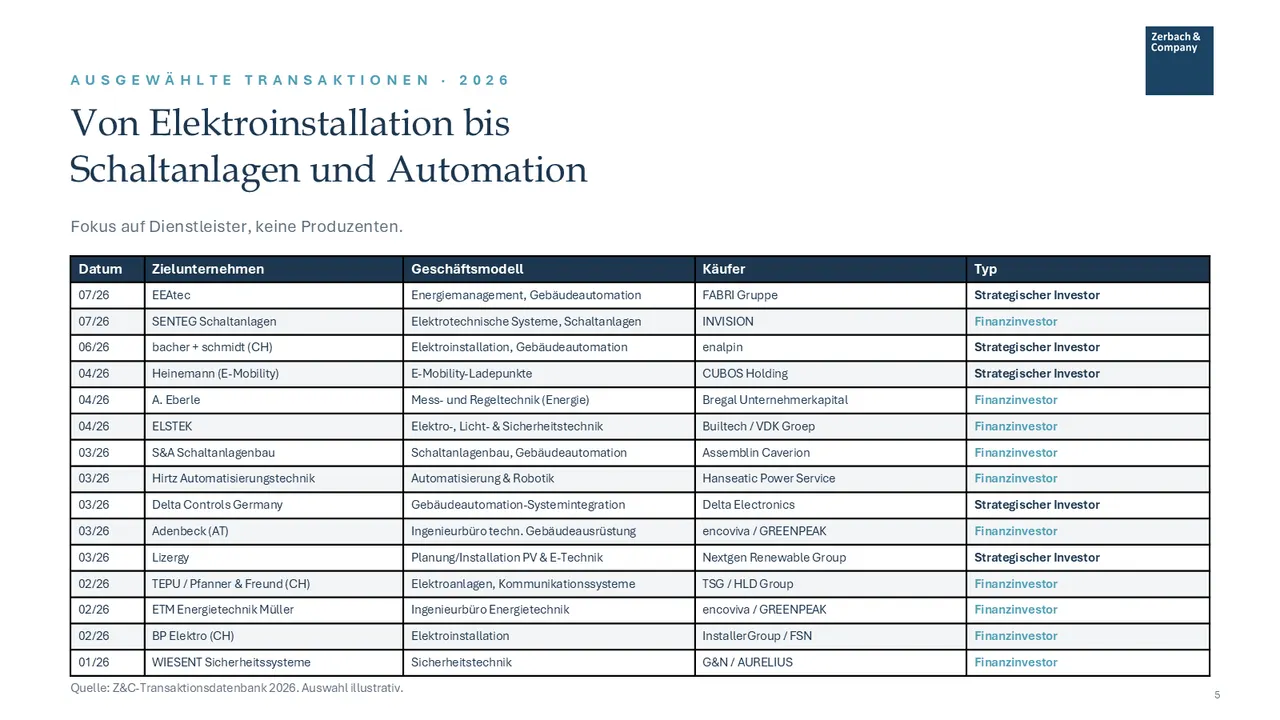
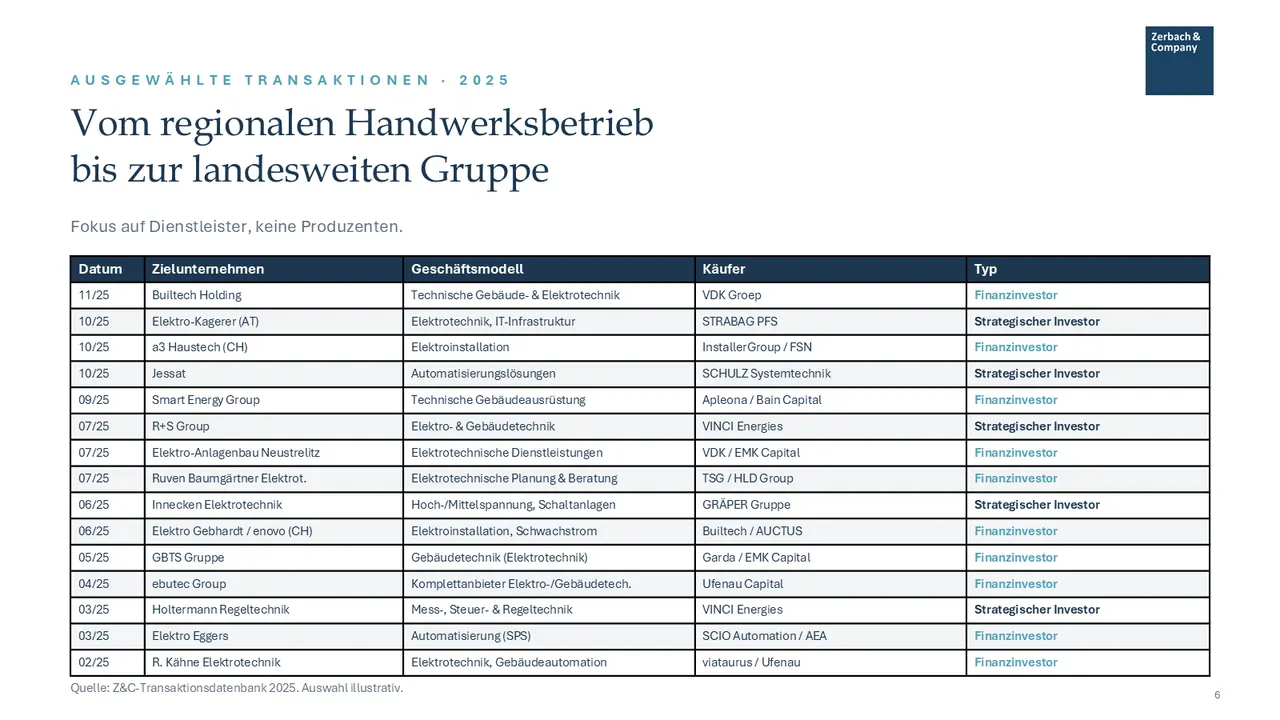
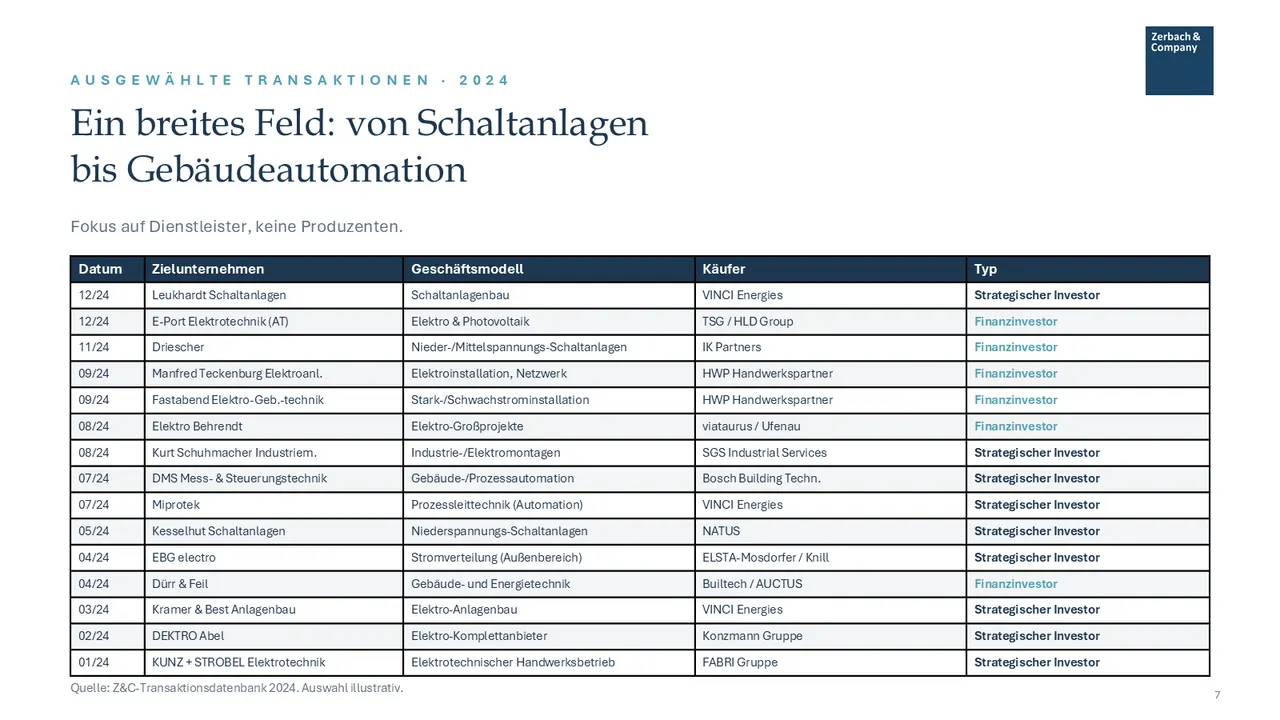
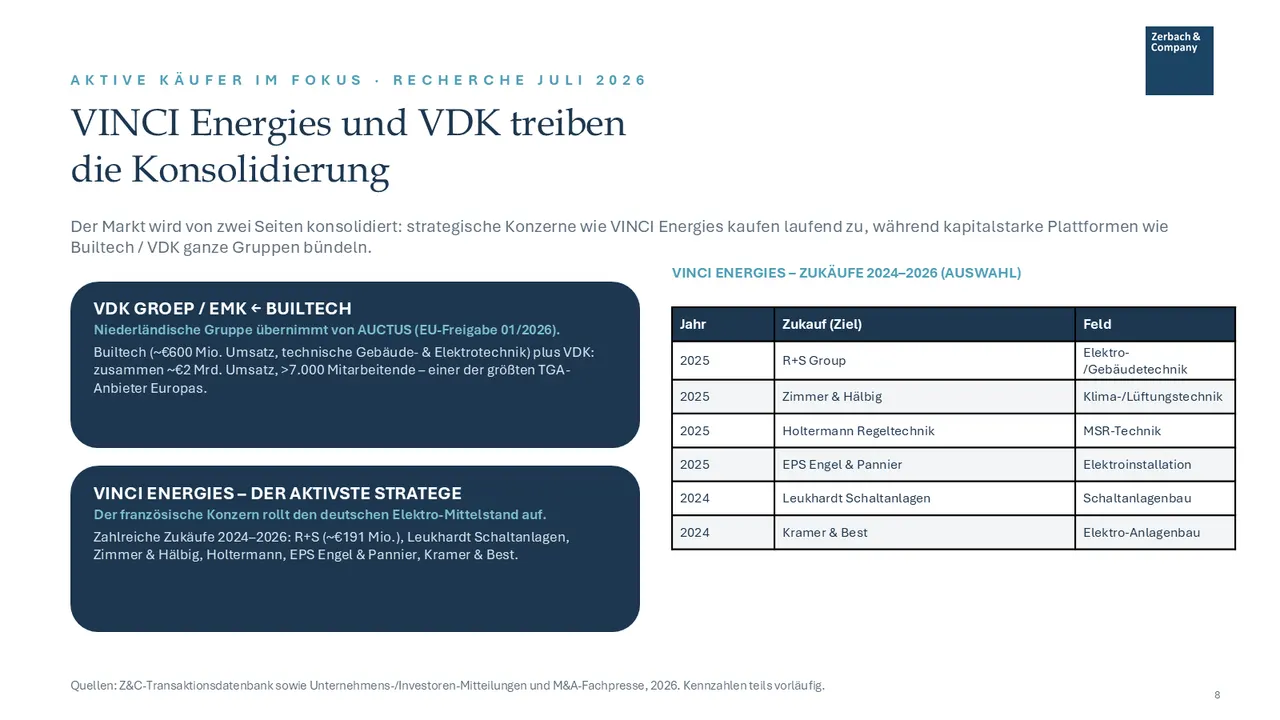
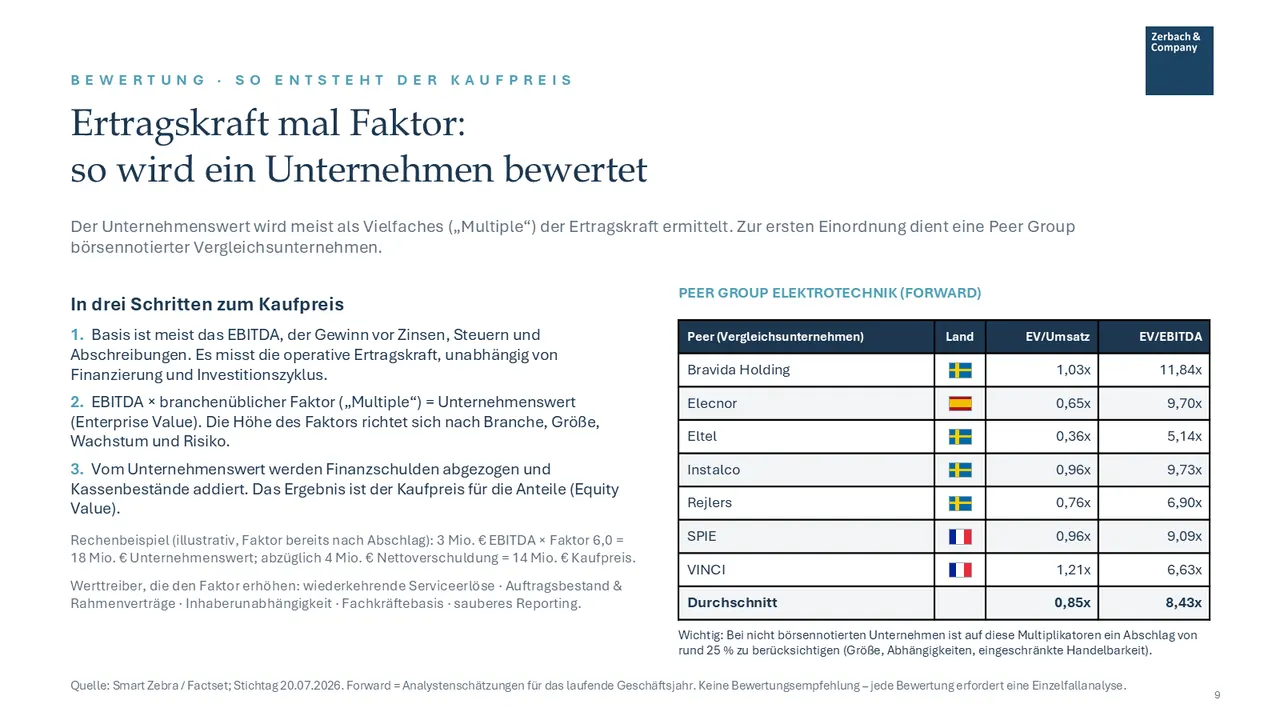
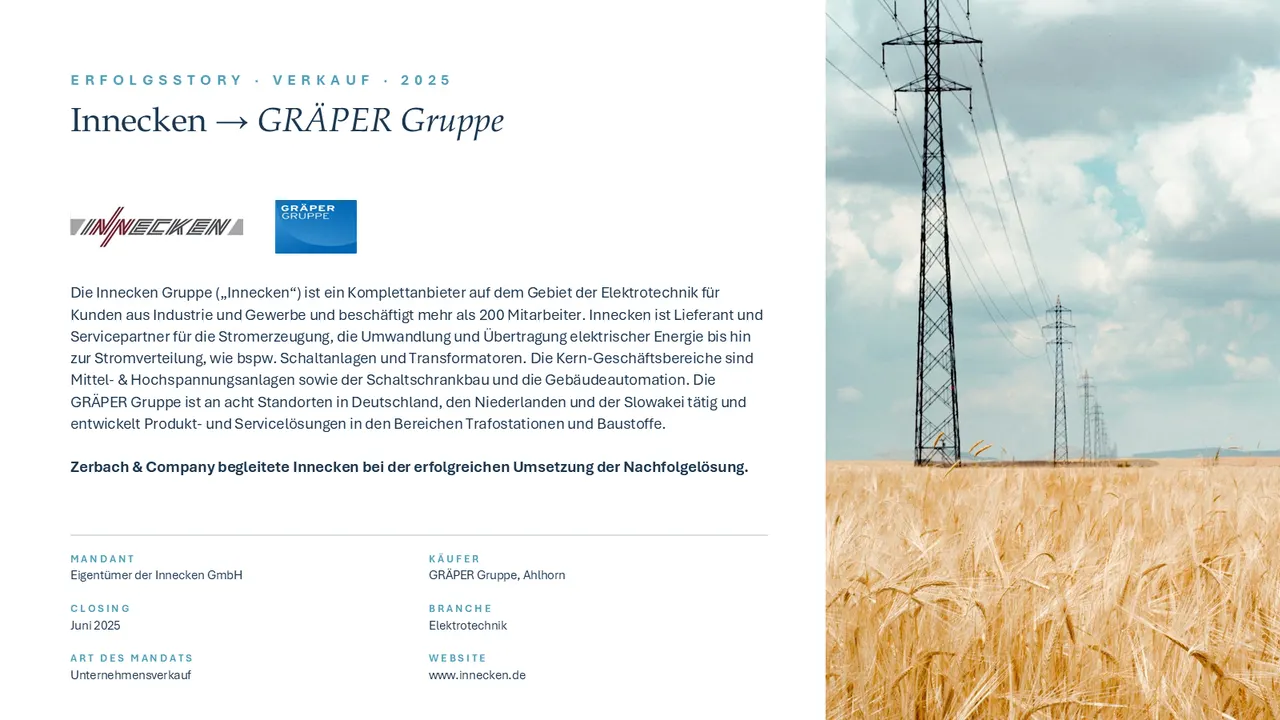
Scroll through the pages; a click opens the page in the PDF. As of July 2026, updated semi-annually. The report is in German.
Market data: construction and infrastructure service providers in the M&A market
For civil engineering, utility line construction, building services and engineering services we publish a separate Industry Update. The key figures of the July 2026 edition:
Active buyers are strategists such as VINCI Energies, STRABAG, SPIE, the Zech Group, Colas / Bouygues, Sweco, Implenia and Instalco, as well as capital-backed construction and trade groups such as TERRAS / AUCTUS, KONZMANN / KLAR, encoviva / GREENPEAK, Builtech / VDK Groep, bluu unit / Triton, HWP Handwerkspartner and InstallerGroup / FSN. Even the consolidators change hands: TERRAS goes to H.I.G. Capital in 2026, Builtech to VDK Groep.
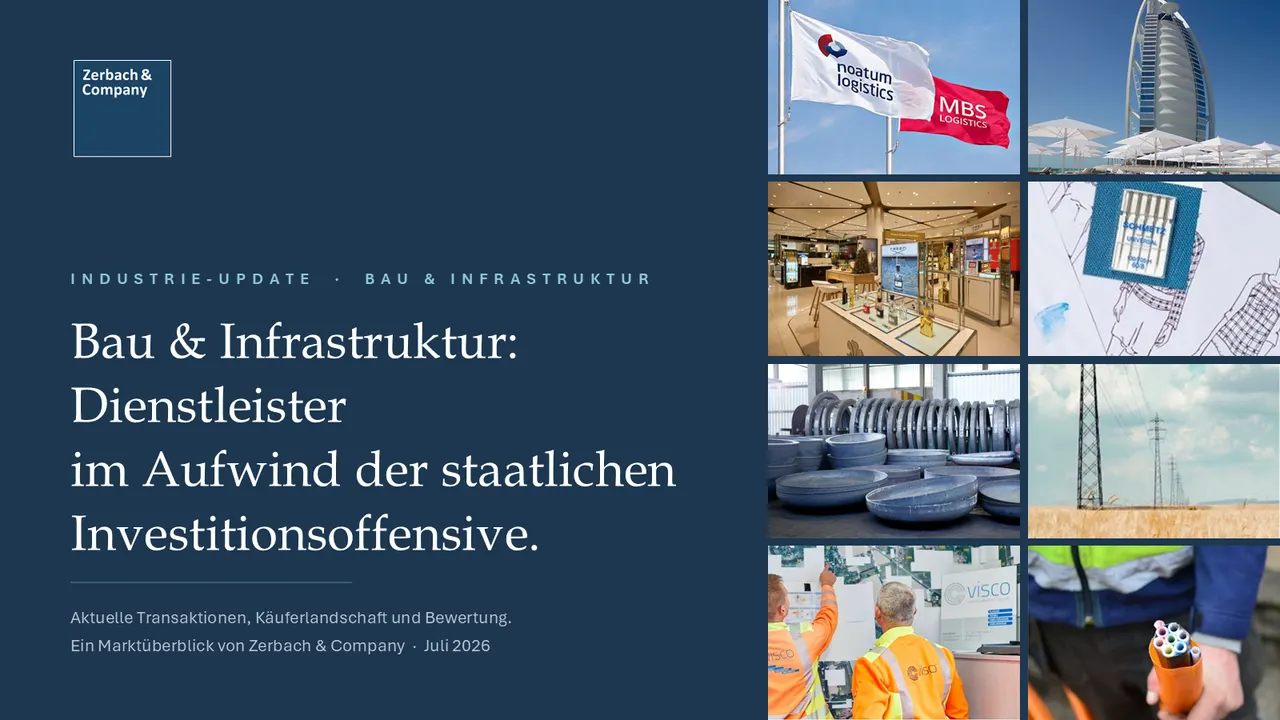
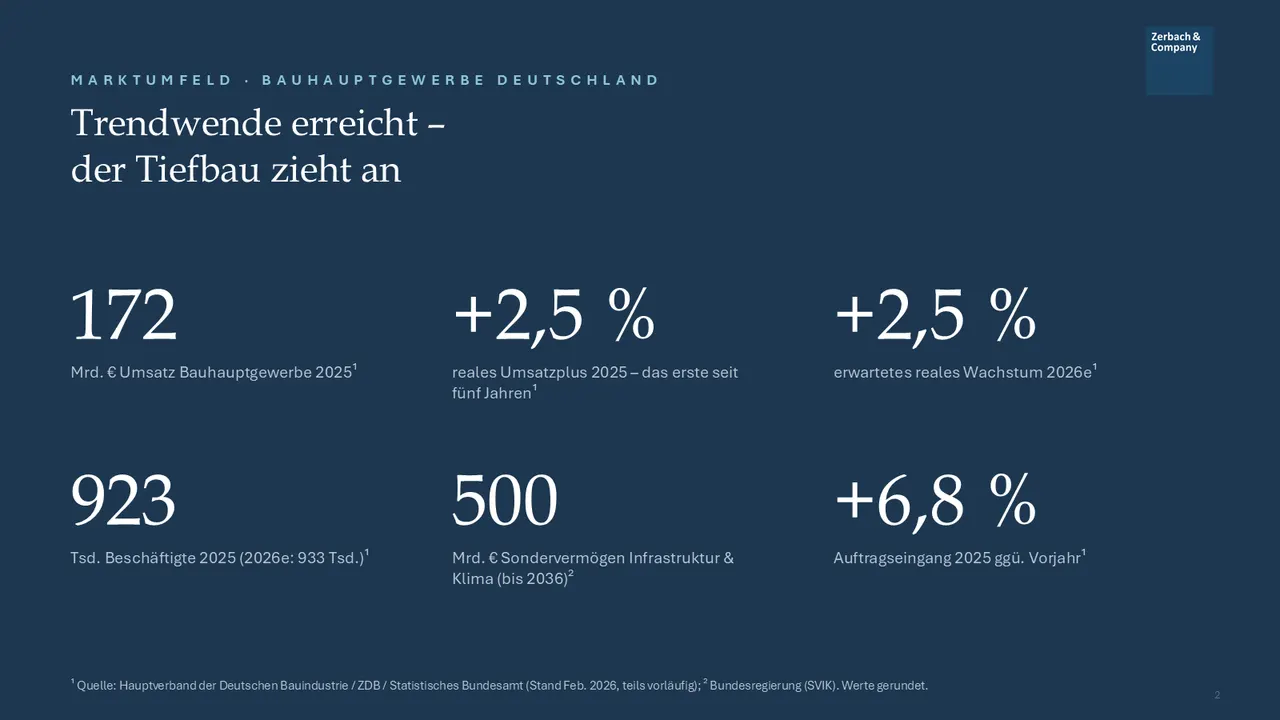
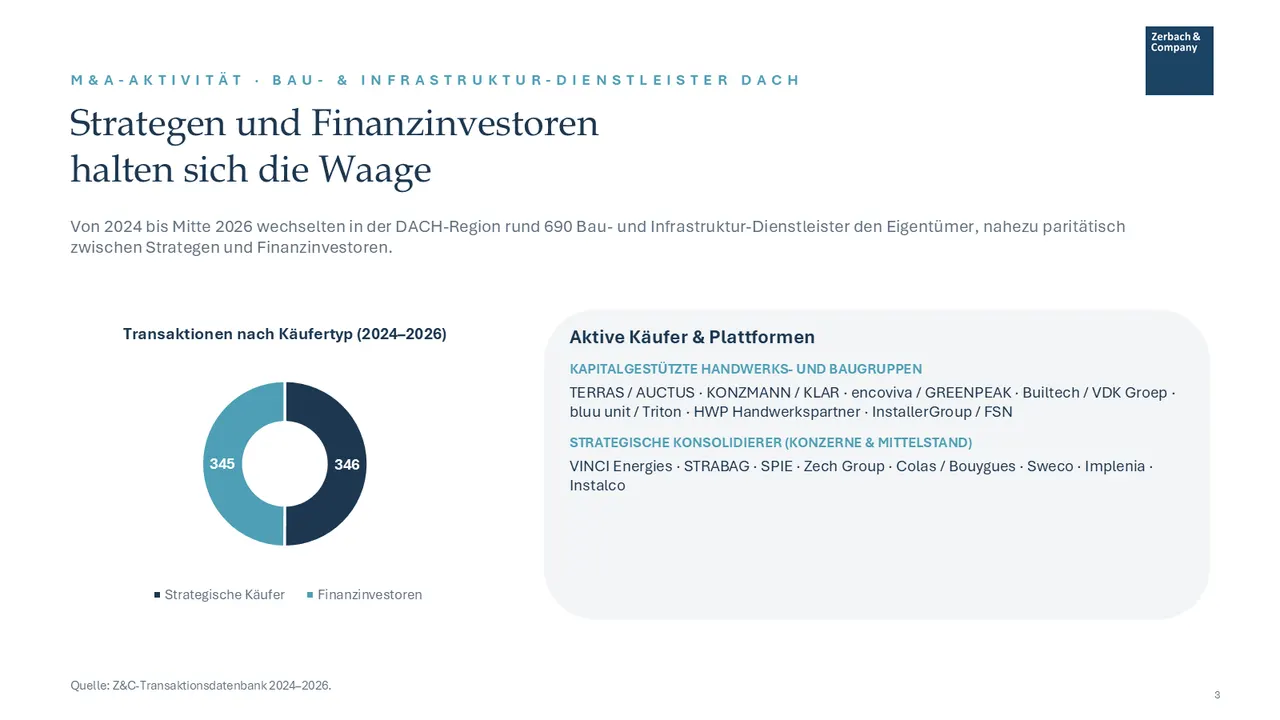
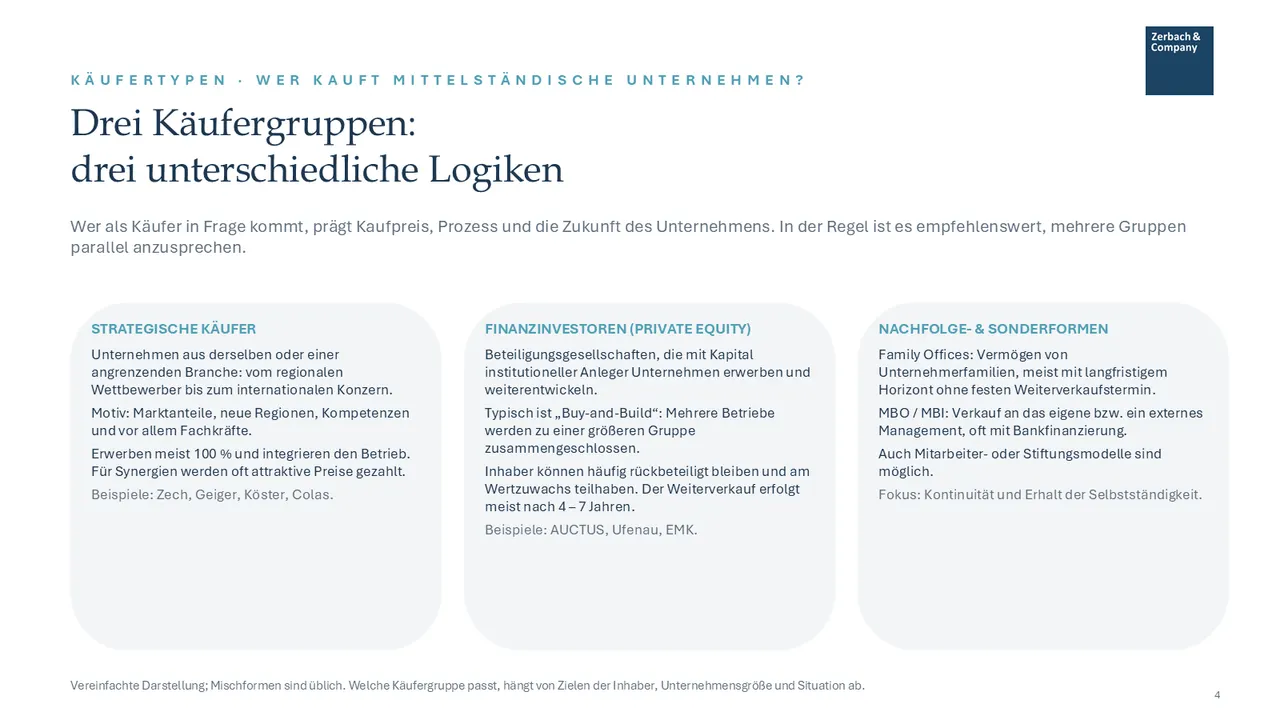
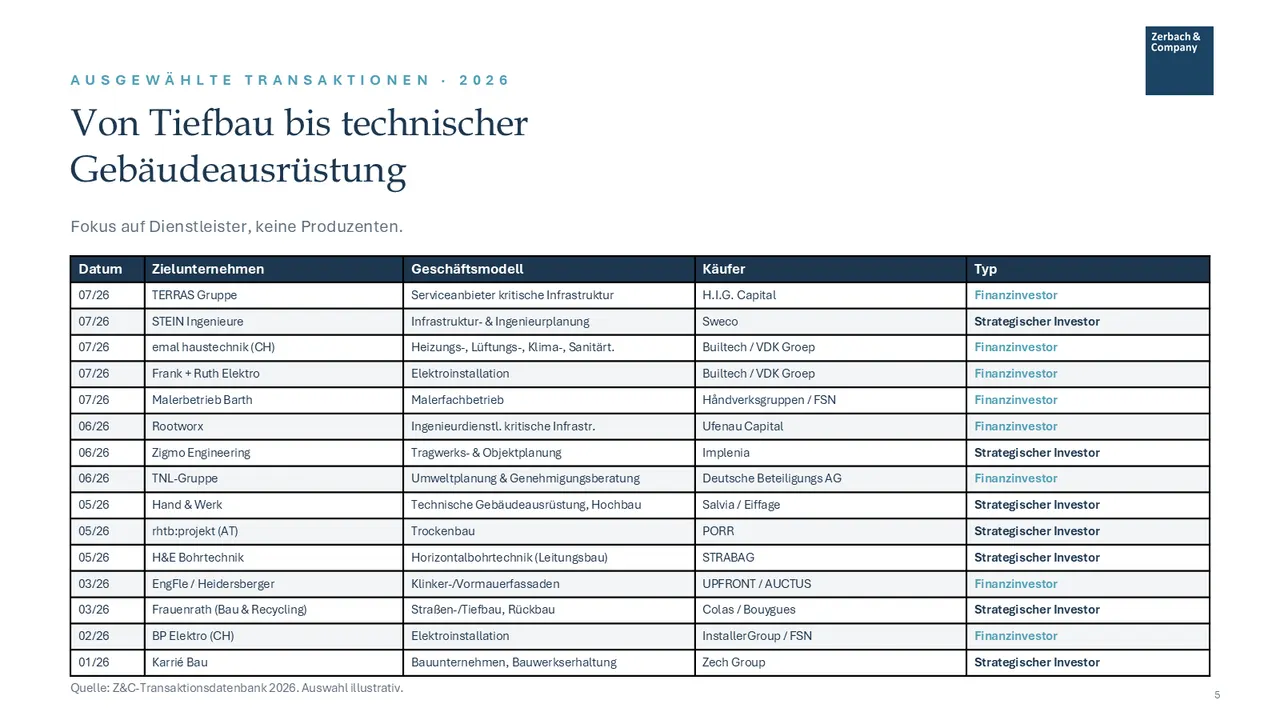
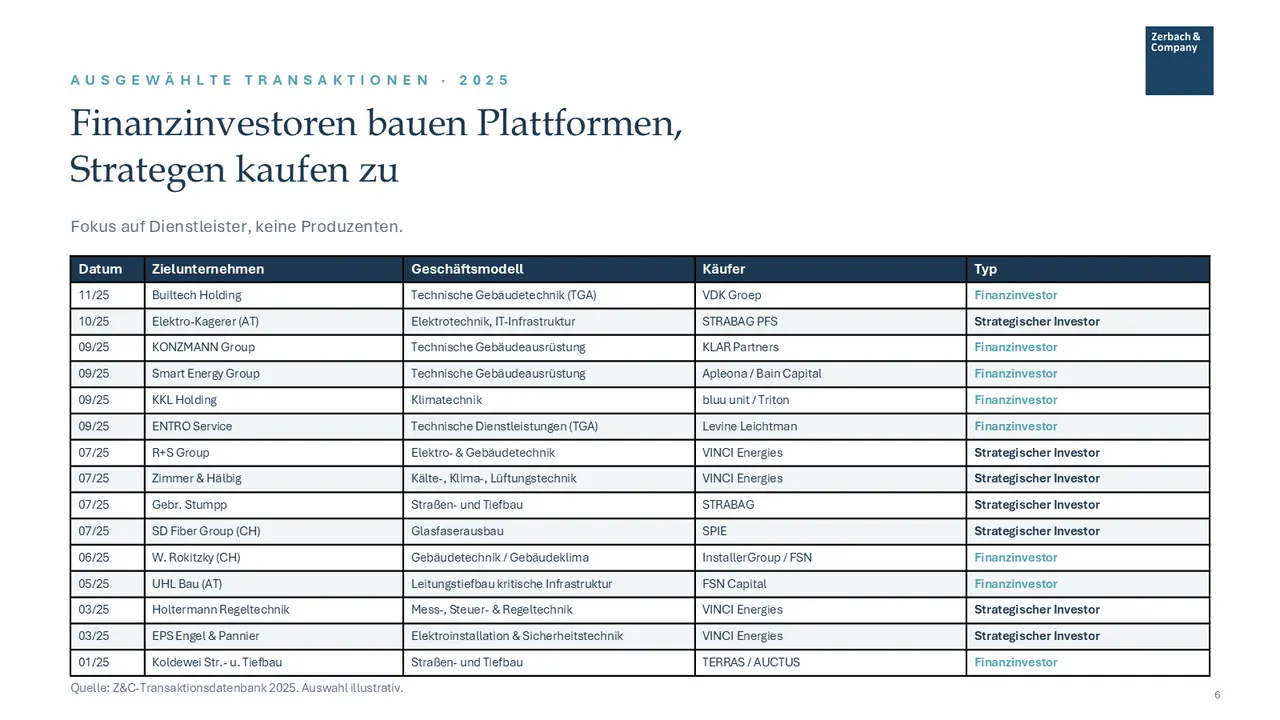
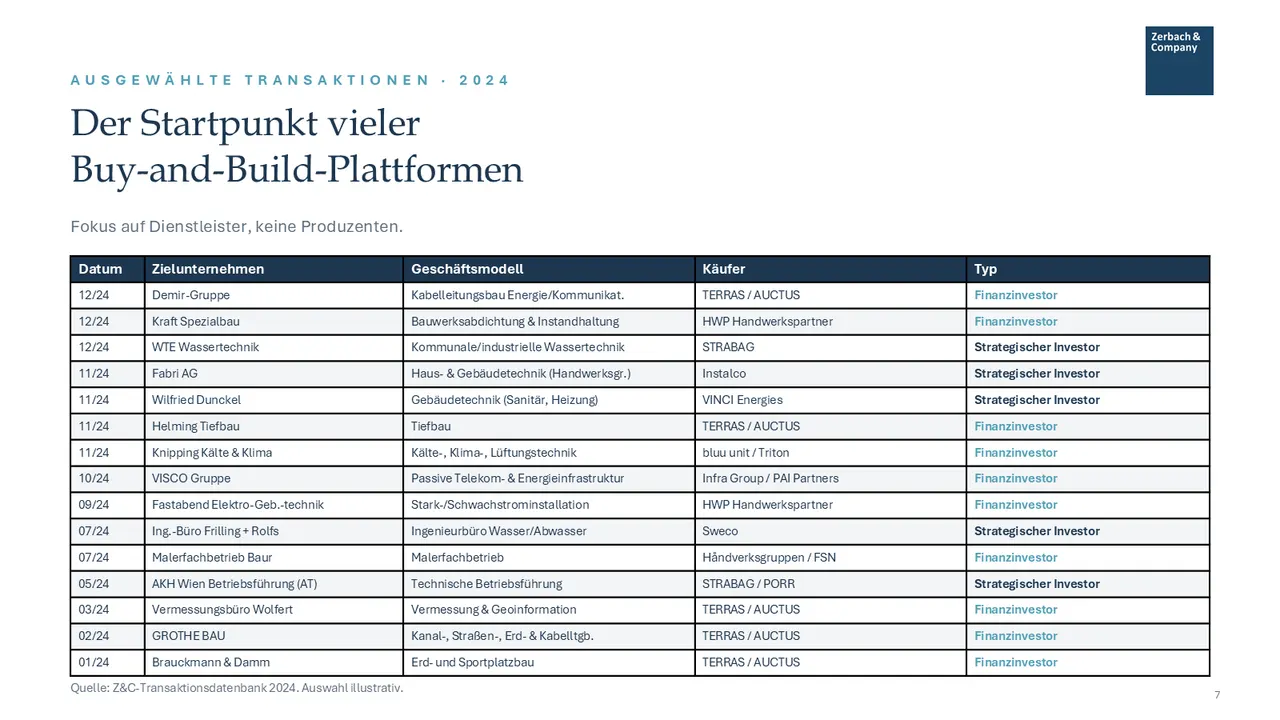
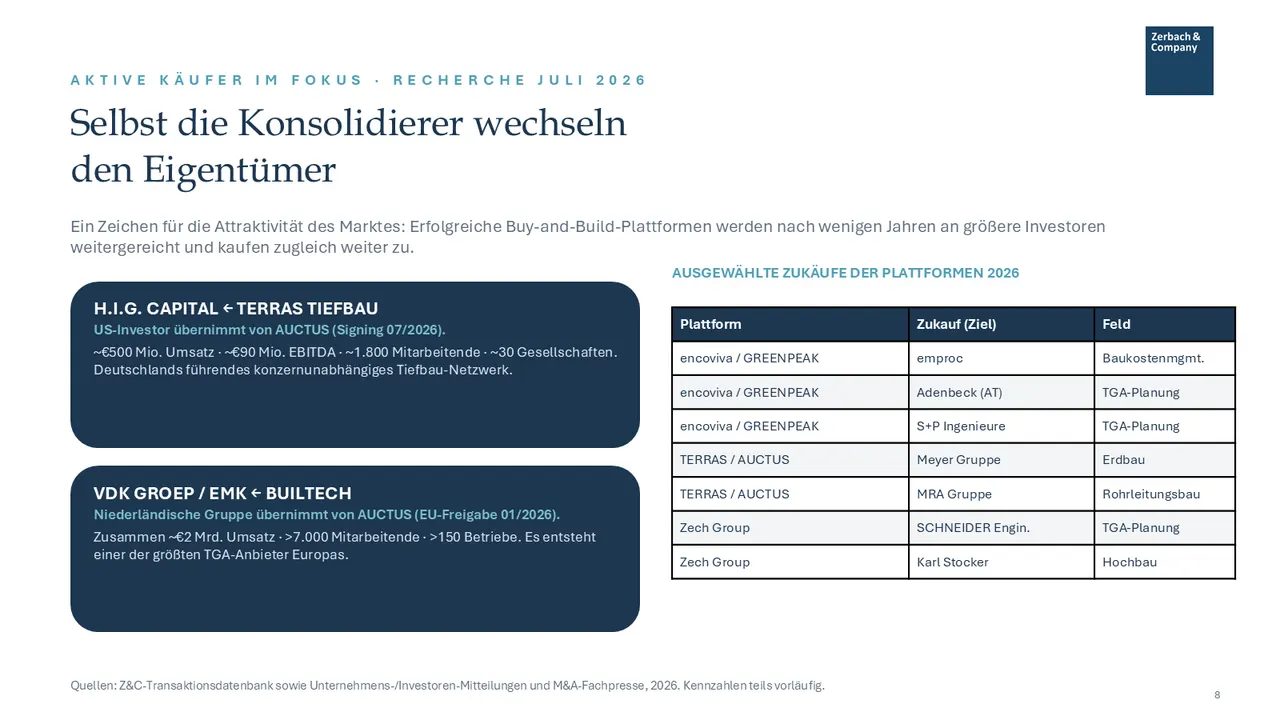
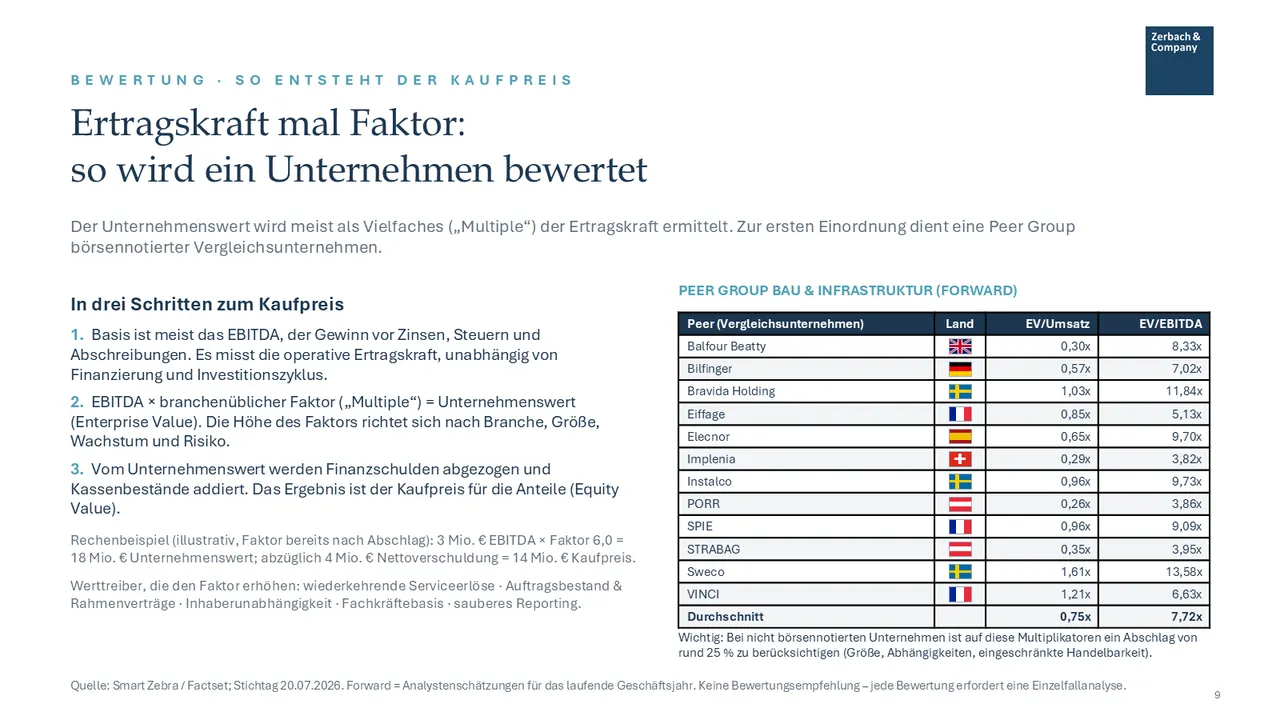
Scroll through the pages; a click opens the page in the PDF. As of July 2026, updated semi-annually. The report is in German.
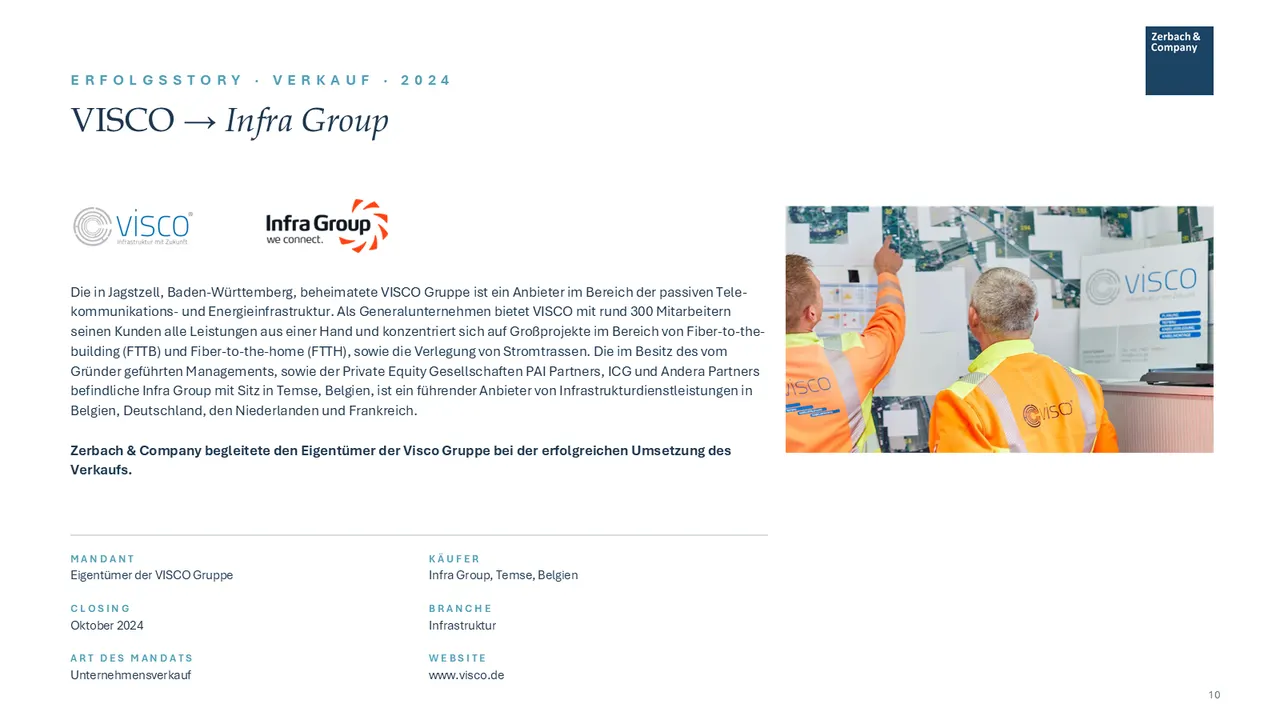
VISCO Group → Infra Group (Belgium)
VISCO Group from Jagstzell in Baden-Württemberg is a general contractor for passive telecommunications and energy infrastructure: large-scale fibre roll-out projects (FTTB/FTTH) and the laying of power lines, all from a single source, with around 300 employees. The owner sold his shares to Belgian Infra Group, a leading infrastructure service provider in Belgium, Germany, the Netherlands and France owned by its founder-led management and the private equity firms PAI Partners, ICG and Andera Partners. The existing management team led by the previous owner continues to run VISCO unchanged.
Read the full announcement →Five transactions, three buyer types
Strategic grid service provider, international infrastructure group with private equity shareholders, Mittelstand-focused investment company: our transactions in the sector show the range of buyers and solutions.
INNECKEN / ENERVISION → GRÄPER
Electrical engineering, energy software
VISCO Group → Infra Group (Belgium)
Fibre and energy infrastructure, around 300 employees
DuoTherm Rolladen → BPE
Sun protection and building elements, today part of the Stella Group
FEA Reinehr → AEVDM Invest
Security and communication technology, Swisttal
ELP → Prime Light / BayTree
Emergency lighting, United Kingdom
Sector knowledge first hand
Three members of our Industry Advisory Board know the sector as entrepreneurs and industry representatives. They support us in assessing business models, approaching buyers and holding conversations at eye level.
Dr. Ulrich Viethen
Managing Director MURR Elektronik, Board Member ZVEI (German Electro and Digital Industry Association) and Board Member VDMA Electrical Automation Association
Ralf Hammer
Owner and shareholder of various infrastructure companies (energy and telecommunications)
André Barth
Founder DuoTherm Rolladen GmbH (today part of the Stella Group)
Questions about selling an electrical or building services company
What is my electrical or building services company worth?
The purchase price is derived from sustainable EBIT or EBITDA and a multiple that depends on size, service share, customer structure and owner dependence. Between an owner-centred trade business and a company with a second management level and framework contracts, the difference can quickly be a factor of two. Our fixed-price company valuation provides a reliable first assessment.
Who buys electrical, building services and grid construction companies?
Three groups: strategic buyers such as grid service providers, utilities and building technology corporates; private equity investors building buy-and-build platforms; and international infrastructure groups seeking a foothold in Germany. Only a parallel process shows which group offers the best price and the most suitable solution.
What happens to my employees?
In this sector, buyers are above all acquiring the team, so continuity is in their own interest. Employment contracts transfer unchanged in a share sale. Commitments on location, management and employment can be anchored in the purchase agreement; we make them part of the buyer selection.
Do I have to stay on after the sale?
Buyers usually want a transition period of one to three years, which grows with owner dependence. Building a second management level early shortens it. Alternatively, a reinvestment lets you participate in further value creation, for example within a platform.
How long does the sale take?
From preparation to signing we plan for six to nine months. Preparation covers documents, valuation and the anonymised approach; offers, due diligence and contract negotiation follow. Confidentiality towards customers, employees and competitors is maintained until signing.
Do you run a company in electrical, building or energy technology?
The first conversation is non-binding and, of course, confidential.